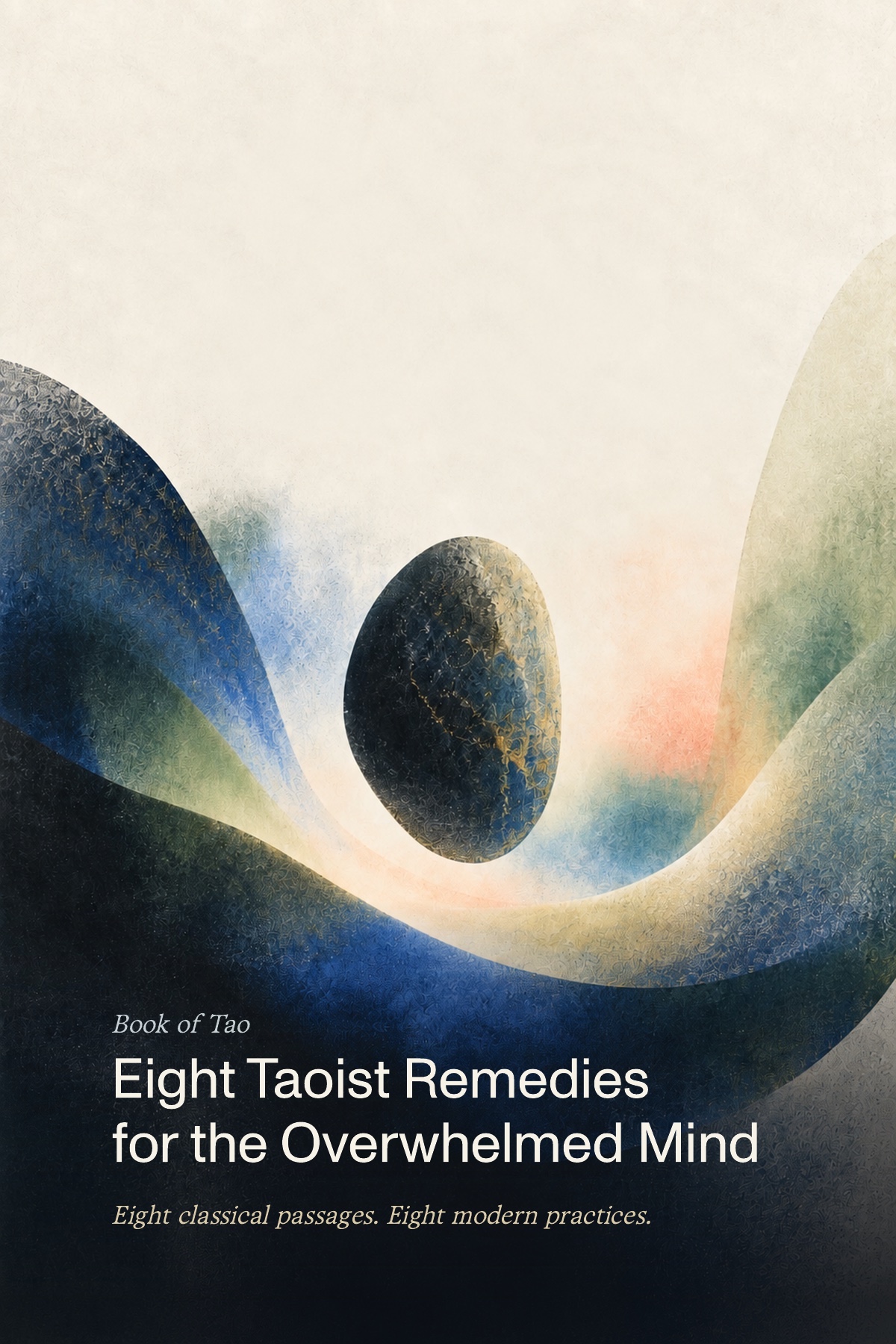
Taoist meditation done outdoors isn't a wellness hack bolted onto an old philosophy. It's closer to a return. The earliest meditative scene in the Taoist textual record, Zhuangzi's account of Yan Hui "sitting and forgetting," already assumes a mind quiet enough to notice the world instead of narrating it. Practicing that outside, with weather and birdsong and bare ground doing half the work, isn't an innovation. It's closer to the setting the practice was probably built for.
This isn't a system with steps to master. It's wu wei (無爲, effortless action) applied to attention itself. You stop forcing the mind still and let stillness happen the way water finds level ground. What follows is a practical way into that: where the practice actually comes from, a simple four-step way to begin, and an honest look at forest bathing, a real but separate practice that pairs well with it.
Getting Started Outdoors
Finding Your Spot
Pick a spot that lets you settle without effort. A quiet corner of a park, a forest edge, a garden. Somewhere safe, legal to sit in, and easy to reach without a production. Beyond that, the choice matters less than you'd think. The practice doesn't need a perfect location, it needs one you'll actually return to.
Respecting Nature
Follow whatever rules the space has and leave it as you found it. This isn't etiquette for its own sake. Treating the ground you sit on with some care is part of the practice, not separate from it, since the whole point is aligning yourself with something larger than your own agenda.
Where the Practice Comes From
Zuowang: Sitting and Forgetting
The oldest description of Taoist meditation in the surviving textual record comes from the Zhuangzi, chapter 6, in a scene between the student Yan Hui and his teacher Confucius. Yan Hui reports that he has achieved zuowang (坐忘, "sitting and forgetting"): he says he has dropped awareness of his own limbs, dimmed his hearing and sight, and become one with what the text calls the Great Thoroughfare. Confucius, unsettled and curious, asks to be taught. It's a strange scene to build a meditation tradition on, a fictional Confucius outpaced by his own student, but it's the root image nearly everything downstream calls back to. For a closer look at how later Taoist hermits carried this practice forward, see Taoist Hermits and the Art of Zuowang.
Stillness and the Ten Thousand Things
The Tao Te Ching gives the stillness-and-observation approach its own grounding in chapter 16.
"Attain complete emptiness, hold fast to stillness. The ten thousand things arise together, and I watch their return."
Sitting outdoors and watching a season turn, a cloud move, a bird arrive and leave, is close to a literal enactment of that line. You're not meditating on nature as a metaphor. You're doing the thing chapter 16 describes: emptying out enough to actually watch things rise and return.
Chapter 1 supplies the mood more than the method.
"Mystery after mystery, is the gate to all wonders." (Tao Te Ching, chapter 1)
Meditation, read against that line, isn't aimed at a result. You're not solving the mystery. You're sitting inside it with some curiosity instead of trying to close it.
Wu Wei and the Present Moment
Wu wei shows up across the Tao Te Ching (notably chapters 2, 37, and 63) as effortless action, doing without forcing. Applied to meditation, it means you stop battling distraction and start letting your attention move with what's actually around you. If birds are chirping or leaves are rustling, that sound becomes part of the practice instead of an interruption to push through.
Body and Mind Essentials
Sit upright with a relaxed spine, shoulders loose, chin tucked slightly. Breathe from the diaphragm rather than the chest. None of this needs to be exact. The point is a body settled enough that it stops competing with the mind for attention. For more on how breath specifically ties into this tradition, see How Breath Awareness Aligns with the Tao.
A Simple Way to Practice Outdoors
Step 1: Ground Yourself
Sit on the ground if you can, shoes off. Rest your hands palms-down on your thighs and close your eyes. Notice where your body actually touches the earth, the texture under you, grass or dirt or stone. Let that contact be the anchor.
Step 2: Focus on Your Breathing
Take a few deep breaths, then let the exhale run a little longer than the inhale. Don't count it out with precision, just let it settle into something unforced. Once it finds its own rhythm, stop managing it and let it run on its own.
Step 3: Connect with Nature
Move through your senses one at a time. Sound: notice what's near and what's far, without naming it. Smell: whatever the air is carrying. Touch: wind, temperature, texture. Sight, if you open your eyes: take the scene in without fixing on any one part of it.
Step 4: Wrap Up
Wiggle your fingers and toes, roll your shoulders, bring movement back gradually. Take a moment before standing, hands still on the ground, then rise slowly. There's no ceremony required here, just a deliberate transition instead of an abrupt one.
Forest Bathing: A Different Root, A Good Pairing
Shinrin-yoku (森林浴, "forest bathing") is a real practice, but it isn't Taoist in origin. Japan's Ministry of Agriculture, Forestry and Fisheries coined the term in 1982 as a public health initiative encouraging people to spend time in forests. It's a modern, government-originated practice being paired here with an ancient Chinese one, not the same tradition under two names.
The pairing works because the two practices lean toward the same thing from different directions. Forest bathing is slow, sensory, and immersive: moving deliberately, breathing deeply, taking in the environment through every sense without analyzing it. Taoist meditation in nature leans more toward stillness and alignment with the Tao. One is largely about sensory presence, the other about inner stillness married to that presence. Combined, they cover more ground than either does alone.
Combining the Two
- Start with grounding. Begin standing, feet rooted, before you move.
- Practice wu wei movement. Let your body move through the space without forcing pace or direction.
- Pause for sensory meditation. Stop periodically to sit and let the forest's sounds and textures come to you rather than chasing them.
When the Outdoors Interrupts You
Distractions outside are constant, and Taoist practice treats that as material rather than a problem. Unexpected sounds, bird calls, rustling, distant traffic, become something to notice and let go of rather than push against. If wildlife comes near, keep a respectful distance, stay calm, and let the animal move through on its own terms.
Weather changes the shape of the practice rather than ending it. In rain, find shelter under dense trees and let the sound of it become the focus. In strong wind, sit with your back to it and let the breeze do some of the work. In heat, meditate earlier in the day and favor a slower, cooler breath. In cold, keep the session short and add movement, a walking meditation holds up better than sitting still when you're losing warmth.
Making It a Habit
Start small, ten to fifteen minutes outdoors, and let the practice grow on its own schedule rather than a plan. A short session at sunrise, gratitude at breakfast for where your food actually came from, a minute spent looking out a window before the day starts, all of it counts. A commute can become a walking practice. A break at work can be five minutes of paying attention to whatever's outside, instead of a screen. That's wu wei applied to an ordinary day, finding the rhythm that's already there instead of imposing one. For more ways to build this kind of daily rhythm, see A Simple Guide to Taoist Meditation Techniques.
Seasons can shape the practice too, if you let them. Spring and summer mornings tend to suit more energetic sessions. Fall and winter afternoons tend to pull toward something quieter and more reflective. None of this is a rule, just a way of letting the outside world set the pace instead of your calendar.
None of this is really about achieving a state. It's closer to what Yan Hui described to a startled Confucius: not concentrating harder, but forgetting on purpose, until the line between you and the ground you're sitting on gets a little less certain.
FAQs
Is nature important in Taoist meditation?
It's central to how the practice is usually framed, though not strictly required. The Tao Te Ching's chapter 16 describes watching the ten thousand things rise and return, an image drawn directly from the natural world, which is part of why sitting outdoors is such a natural fit for the practice rather than an optional upgrade.
Do I need special techniques to meditate outdoors?
No. The practice, going back to the zuowang scene in Zhuangzi chapter 6, emphasizes letting go rather than mastering a method. Posture and breath awareness help, but the core of it is presence, not technique.
Can Taoist meditation be informal?
Yes. Walking, sitting, or simply observing your surroundings can all count, as long as the mind is settled rather than performing. Wu wei (無爲) itself is about not forcing a rigid structure onto the practice.
What is zuowang, and how does it relate to meditating outdoors?
Zuowang (坐忘, "sitting and forgetting") is the earliest documented meditation practice in Taoist literature, from a dialogue between Yan Hui and Confucius in Zhuangzi chapter 6. It describes forgetting the body and ordinary senses to merge with something larger, which is the same basic move an outdoor sit is trying to make with the natural world instead of an abstraction.
Is forest bathing a Taoist practice?
No. Shinrin-yoku was coined in 1982 by Japan's Ministry of Agriculture, Forestry and Fisheries as a modern public health practice, not a Taoist one. It pairs well with Taoist meditation because both value sensory presence in nature, but they come from different traditions centuries apart.
How long should an outdoor session last?
Ten to fifteen minutes is a reasonable starting point. Length matters less than consistency, and the Taoist framing of the practice favors letting a session's length develop naturally rather than hitting a target duration.
Other in
Practice



on our social media


Never miss an update with Tao Te Ching Translations. Subscribe to our email list.
YOUR EMAIL
JOIN NEWSLETTER