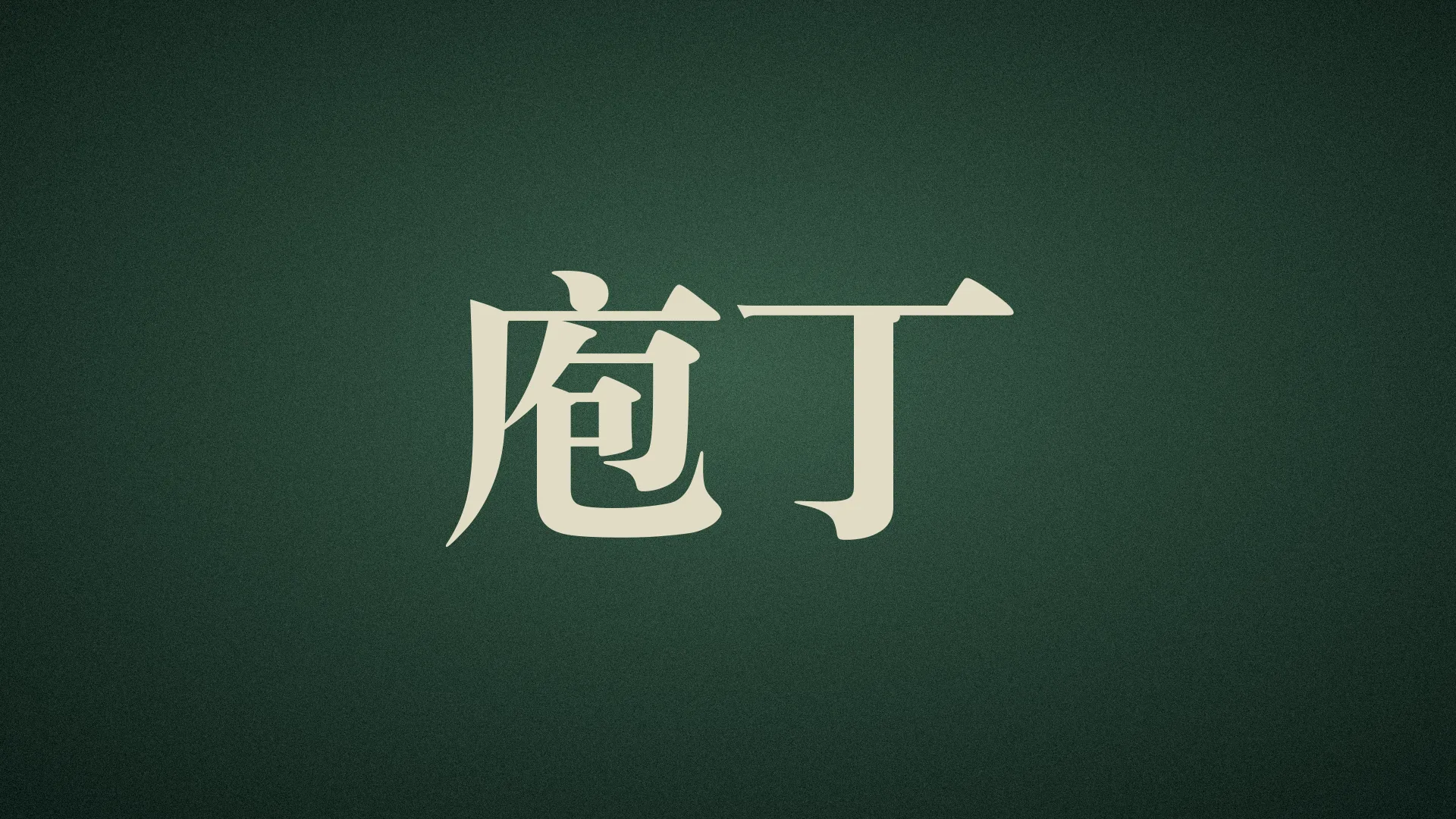
Cook Ding is often retold as a story of effortless mastery, the blade that never dulled and the moral that skill makes hard work look easy. The Zhuangzi keeps going. After nineteen years with the same knife and thousands of oxen behind him, Ding says he still reaches places where meat and bone tangle together, and there he gets wary, fixes his eyes, and slows his hands.
That moment is easy to skip, and it says something the graceful part can't: skill doesn't remove the hard spots, it changes how you meet them.
The Scene in Zhuangzi 3
The story sits in the third of the Zhuangzi's seven Inner Chapters, titled 養生主 (Yǎngshēng zhǔ), which translators render along the lines of "the principal of nourishing life." Herbert Giles, in his 1889 translation, called it "Nourishment of the Soul." A cook named 庖丁 (Páo Dīng) is carving an ox for Lord Wenhui (文惠君, Wénhuì jūn). The text lists every part of his body at work, hand, shoulder, foot and knee, and says the sound of the knife falls in time with two pieces of music, the 桑林 (Sānglín) dance and the 經首 (Jīngshǒu) movement.
Páo (庖) means a cook or kitchen hand, and Dīng (丁) is either his name or a word for a kitchen servant. Cheng Xuanying, a Tang dynasty commentator, allows both. He also says Lord Wenhui is King Hui of Liang, an identification the passage itself never makes. Giles noted in 1889 that commentators were already divided about what the two pieces of music were.
Wenhui watches and asks whether skill can really reach this point. Ding sets down his knife and answers that what he loves is 道 (dào, "the Way"), which goes beyond skill (進乎技矣, jìn hū jì yǐ). Then he explains how the ox came to look different to him over the years.
The Line Before the Story
Before the cook appears, the chapter opens with a warning: 吾生也有涯,而知也無涯 (wú shēng yě yǒu yá, ér zhī yě wú yá). Giles renders it "My life has a limit, but my knowledge is without limit," and continues that to drive the limited in search of the limitless is fatal. The word 涯 (yá) is a shoreline or boundary. The text never says what kind of knowing it means or connects the line to the ox, so the link is the reader's to make.
The two old commentators hear it differently, and neither hears "too much information." Guo Xiang (died 312 CE), whose notes are embedded in the standard text, says each of us is given a portion with its own limit. He then turns to people who love reputation and winning, who push past their strength and are never satisfied. As Guo hears it, the limitless knowing is a hunger for status. Cheng Xuanying, writing in the Tang, calls it 分別之智 (fēnbié zhī zhì), "discriminating knowledge," which chases after things without end.
Our reading, labeled as ours: Cheng's phrase comes close to what it feels like when every choice splits into ten more. The chapter never says so, and Guo Xiang's version is more about ambition than options.
Ding's Three Stages
Ding gives Lord Wenhui a short history of his own eyes. It has three stages, and Guo Xiang's notes on each are worth having beside the text.
- At the start, 所見無非牛者 (suǒ jiàn wú fēi niú zhě), "all I saw was ox." Guo Xiang glosses this as not yet being able to see the gaps.
- After three years, 未嘗見全牛也 (wèi cháng jiàn quán niú yě), "I never saw a whole ox." Guo says he now saw only the gaps.
- Now, 臣以神遇而不以目視 (chén yǐ shén yù ér bù yǐ mù shì), "I meet it with spirit and don't look with the eyes," and 官知止而神欲行 (guān zhī zhǐ ér shén yù xíng), "the senses stop and spirit wants to move." Guo reads this as the inspecting faculties set aside while the mind follows the pattern freely.
Translators differ on 神 (shén). Giles uses "mind," and the word is also commonly rendered "spirit." Both choices are defensible.
Three working terms carry the rest. 天理 (tiānlǐ) is the natural pattern, the way the ox is put together. 因其固然 (yīn qí gùrán) means going by how it already is. And 以無厚入有間 (yǐ wú hòu rù yǒu jiān) means putting a blade with no thickness into a gap, because joints have gaps and a thin enough edge finds room.
The numbers are in the text. A good cook changes his knife every year because he cuts, an ordinary cook every month because he hacks. Ding's knife is nineteen years old, it has carved thousands of oxen, and Giles has its edge "as if fresh from the whetstone." One precision worth keeping: nineteen is the age of the knife. The passage doesn't say how long Ding has been a butcher.
The Knot Most Retellings Skip
Right after the boast, Ding turns with one word, 雖然 (suīrán), "even so." Then comes the passage that decides how to read the whole story: 每至於族,吾見其難為,怵然為戒,視為止,行為遲,動刀甚微,謋然已解,如土委地 (měi zhì yú zú, wú jiàn qí nán wéi, chùrán wéi jiè, shì wéi zhǐ, xíng wéi chí, dòng dāo shèn wēi, huòrán yǐ jiě, rú tǔ wěi dì).
Taken one clause at a time, it says that whenever he comes to a 族 (zú), a place where things are tangled and bunched, he sees that it's hard. He grows wary. His looking fixes and stops. His movement slows. The blade moves very slightly, and then the part comes apart "like earth crumbling to the ground." Giles gives the same beat in his own words: "I am all caution. I fix my eye on it. I stay my hand."
Guo Xiang's notes are short and specific. On the tangle he writes that where things cross and knot together is called 族. On the fixed gaze, that Ding no longer turns his eyes to anything else. On the slow movement, that he slows his hands. On the tiny stroke, that when you get it right you use little force. Cheng Xuanying adds that even with the gaps in view, Ding never fails to give the difficulty his attention.
The passage seems to contradict itself here. The same cook who says he doesn't look with his eyes also has his gaze come to a halt at the hardest spot, and Guo Xiang reads that as concentration. The text doesn't say whether "spirit" and attention are separate. One reading is that mastery didn't make Ding stop looking. It taught him where to look.
The ending is quiet. Ding lifts the knife, stands, looks around, wipes the blade and puts it away. Wenhui's takeaway is about life and not butchery: he says he's learned how to nourish life. Guo Xiang's note is one line, and it's the neatest summary of the whole story: since a blade can be looked after, we know life can be too.
How the Commentators Read It
Guo Xiang and Cheng Xuanying both take the story as about living, and neither treats it as a lesson about work. Guo says Ding is only lodging a principle in a craft, and that what he loves isn't the craft. Cheng says outright that the text borrows the cook to explain the art of nourishing life, and he maps each stage of Ding's training onto a student of the Way.
Cheng also reads a symbol into the number nineteen. His subcommentary says ten is a yin number and nine is a yang number, so nineteen years means reaching the height of yin and yang. The passage never says this, and it's a good example of how much interpretation sits between the text and any modern explainer. His vocabulary is also tinted with the language of emptiness (空), which is familiar from Buddhism, so his Tang reading isn't necessarily the one the chapter's first audience would have had.
His comment on the knot echoes Guo's. When the accomplished person meets difficulty, he says, caution is still required. That's our paraphrase of his note, and it lines up with the plain sense of the passage. You can read both commentaries in the Wikisource transcription of the Nanhua zhenjing zhushu, with Guo's notes marked 〔注〕 and Cheng's 〔疏〕.
What the Text Leaves Open
Three questions stay open. The first is whether this is about skill or something past skill. Ding says 道 goes beyond 技 (jì, "craft"), and Guo agrees, but neither tells you how years of practice turn into that, or whether they do.
The second is whether the story is really about work at all. Lord Wenhui's own conclusion is about nourishing life, and the chapter around it is about living out your years without wearing yourself down. A reader who takes it as a productivity parable is reading against the chapter's frame.
The third is that nothing here mentions deciding. Ding never chooses between two options. He finds a structure that's already there and works along it.
A Modern Use, Clearly Ours
Everything above is classical source and commentary. This section is our reading, and the Zhuangzi never suggests it.
When you can't decide between two options, the pressure to resolve it often turns into more effort spread everywhere at once: another list, another opinion, another round of replaying it. Ding's habit suggests something narrower. Find the knot, the one place where the choice is actually tangled. It might be a missing fact, a value that conflicts with another, or a fear about one outcome. Look only there, and try one small move that tests it, like one question to one person or one detail checked, and see whether it comes apart. Treat it as an experiment, not a method.
For the Taoist idea behind that stance, wu wei (無為, wúwéi, "non-action"), see wu wei in decision making. For a short practice built on this exact scene, Remedy Four in Eight Taoist Remedies takes it up.
What the Story Can't Do
It won't tell you which option is right. Ding's ox has a structure waiting to be found, and he had years of oxen to learn it, three before the whole animal disappeared and nineteen on the same knife. Skill on that scale doesn't compress.
The analogy also strains where the information doesn't exist yet. If the fact you need hasn't happened, there's no seam to find, and how wu wei helps navigate uncertainty is a better place to start. The story is a poor fit for those cases and a decent one for the tangled ones.
The Zhuangzi has other parables that work on the same problem from different angles, gathered in 5 Taoist parables for negative thoughts, and 7 Taoist practices for inner resilience gives Cook Ding a shorter treatment inside a wider list. Neither replaces reading the passage itself.
What the story offers is smaller than a method. It shows what a person who has carved thousands of oxen does at the hard part: he gets careful, slows down, and barely moves the blade.
Sources
- Zhuangzi, chapter 3 (養生主), the received text, from the Chinese Wikisource transcription. It's a transcription and not a critical edition.
- Guo Xiang (died 312 CE), notes, and Cheng Xuanying (Tang dynasty), subcommentary, in the Nanhua zhenjing zhushu, juan 4, on Wikisource.
- Herbert A. Giles, Chuang Tzŭ: Mystic, Moralist, and Social Reformer (Bernard Quaritch, London, 1889), chapter 3, available on English Wikisource. Public domain.
- Guo Xiang and Cheng Xuanying's lines are our paraphrases of the Chinese, not quotations from a published English translation.
Frequently Asked Questions
What does Cook Ding teach in the Zhuangzi?
The passage teaches how skill changes the way you meet a hard task. Ding first sees a whole ox, then only its gaps, then works along those gaps with a blade that never dulls. The commentators Guo Xiang and Cheng Xuanying read it as a story about nourishing life, which is also how Lord Wenhui reads it in the text.
What does 庖丁解牛 mean?
Literally, it means "Cook Ding carves the ox." The four characters compress the story's opening line, 庖丁為文惠君解牛, and name the story. In Zhuangzi 3 the cook is butchering an ox for Lord Wenhui.
What is tianli in Cook Ding's story?
天理 (tiānlǐ) is the natural pattern in the ox, the structure of joints and gaps that Ding follows. He says he relies on it (依乎天理) and goes by how the animal already is (因其固然). Giles renders 天理 as "eternal principles" and has Ding follow "such openings or cavities as there may be, according to the natural constitution of the animal."
Why does Cook Ding slow down at the hard parts?
Because skill in this passage doesn't remove difficulty. At a 族 (zú), a tangle of bone and flesh, Ding says he sees that it's hard, grows wary, and slows his hands. Guo Xiang's note is that when you get it right, you use little force.
Does Cook Ding's story apply to making decisions?
The text never mentions deciding, so any application is our reading and not the Zhuangzi's. One way to read it is that a hard choice usually has one tangled spot, and it helps to slow down and look there instead of pushing everywhere. The story can't say which option is right, and it fits poorly when the information you need doesn't exist yet.
Other in
Practice



on our social media


Never miss an update with Tao Te Ching Translations. Subscribe to our email list.
YOUR EMAIL
JOIN NEWSLETTER