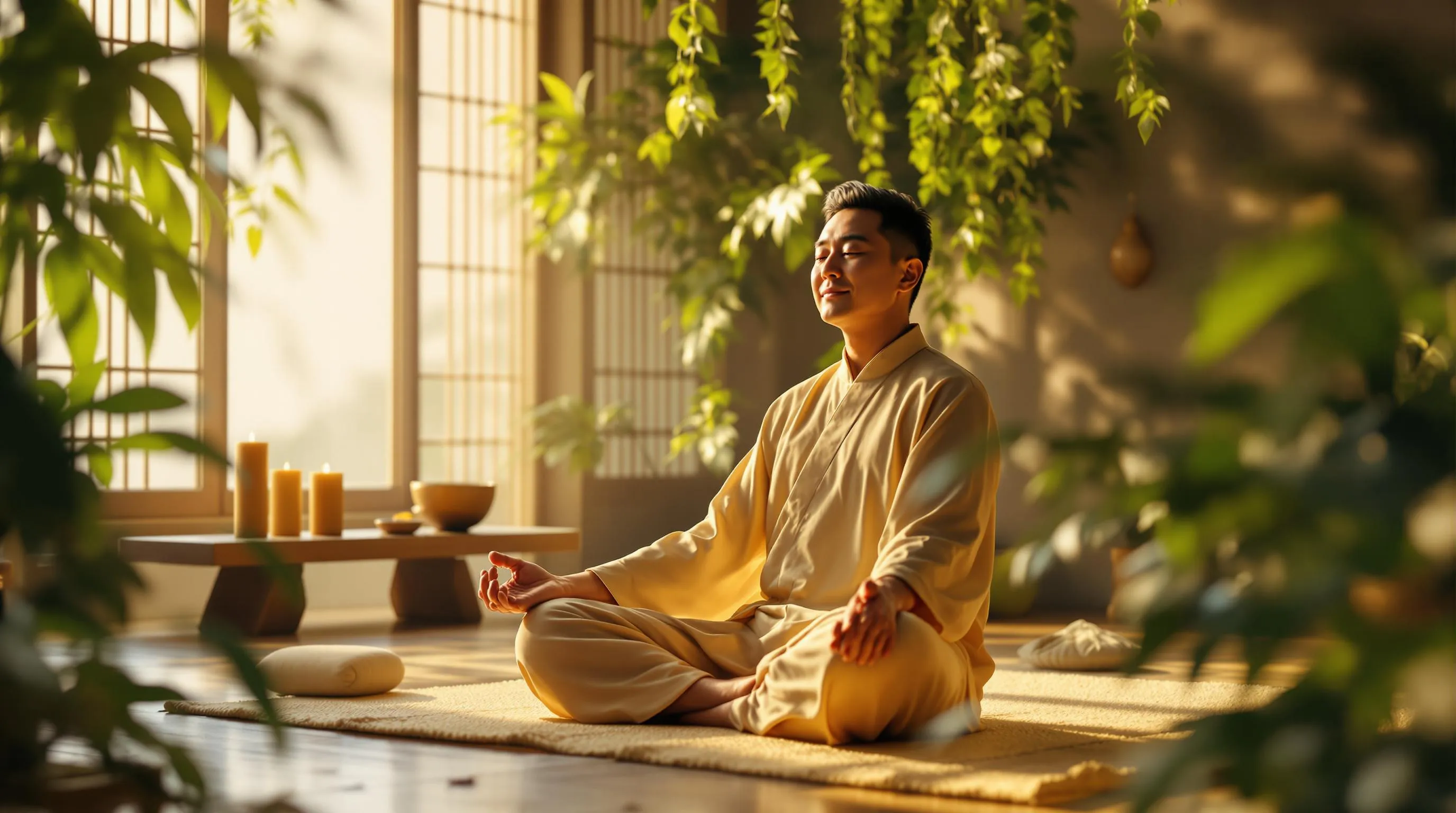
Taoist meditation isn't one technique. It's a family of practices built around breath, visualization, and stillness, developed over centuries to move qi (氣, vital energy) smoothly through the body and settle a busy mind. This guide covers the core techniques a beginner is likely to encounter first.
Breathing Techniques
Taoist Longevity Breathing (also called abdominal or diaphragmatic breathing) engages the diaphragm, abdomen, and lower back on each inhale, rather than the shallow chest breathing most people default to under stress. Circular Breathing extends this into a continuous, unbroken cycle between inhale and exhale, aimed at keeping the breath (and by extension the mind) smooth rather than jagged.
Visualization Exercises
The Microcosmic Orbit is one of the best-documented visualization practices in Taoist internal alchemy (neidan). It involves guiding attention, and by extension qi, along two specific pathways: the Governing Vessel up the spine and the Conception Vessel down the front of the body, forming a continuous loop. Ji-Gam, or "stop-thinking" practice, works differently: instead of moving attention along a path, it rests attention on physical sensation, often warmth or tingling in the palms, as a way to quiet mental chatter without forcing the mind still.
Achieving Inner Stillness: Zhan Zhuang
Zhan Zhuang (站樁), "standing like a post" or standing meditation, holds a static posture, straight spine, relaxed shoulders, knees slightly bent, for an extended period while breathing settles into a natural rhythm. It's a foundational practice in both Taoist internal arts and many martial arts lineages, prized for building body awareness and stillness without the more elaborate visualization the Microcosmic Orbit requires.
A Simple Way to Start
You don't need a formal 20-minute routine to begin. A workable starting shape looks like this: a few minutes of gentle stretching to loosen the spine and joints, followed by a longer stretch of slow abdominal breathing, and closing with a short visualization or a few minutes of Zhan Zhuang if that appeals to you more. Consistency matters more than duration. A short daily practice, done at the same time each day, builds the habit faster than an occasional long session.
Where to Go Deeper
Sinologist Livia Kohn's edited volume Taoist Meditation and Longevity Techniques (1989, University of Michigan Center for Chinese Studies) is a real, scholarly starting point for readers who want the academic grounding behind these practices rather than a simplified app-style version. For structured video instruction, the Wudang Taoist Wellness Academy, based in the Wudang Mountains and led by Master Gu Shining, teaches qi gong, tai chi, and Taoist meditation through an online platform. Neither is affiliated with this site, they're simply real resources worth knowing about.
Frequently Asked Questions
What is the difference between the Microcosmic Orbit and Zhan Zhuang?
The Microcosmic Orbit is a visualization practice, guiding attention along a specific loop through the body. Zhan Zhuang is a standing posture practice with no visualization component, focused instead on stillness and body awareness while holding one position.
Do I need to feel qi moving for these practices to be working?
No. Many practitioners report sensations like warmth or tingling over time, but their absence doesn't mean the practice isn't doing anything. Ji-Gam practice specifically works by resting attention on whatever sensation is present, rather than chasing a specific feeling.
How long should a beginner practice each day?
There's no fixed correct duration. A short, consistent daily practice, even five to ten minutes, tends to build the habit more reliably than an occasional long session. Length can grow naturally as the practice becomes familiar.
Is Taoist meditation the same as mindfulness meditation?
They overlap but aren't identical. Both involve settling attention, but Taoist meditation is built specifically around the concept of qi and its circulation through the body, with techniques like the Microcosmic Orbit that don't have a direct equivalent in most secular mindfulness programs.
What is qi in the context of these techniques?
Qi (氣) is usually translated "vital energy" or "breath." In Chinese medicine and Taoist thought it's the animating force these practices aim to cultivate and circulate. It's a traditional concept, not something with a direct equivalent measurement in Western biomedicine.
Other in
Practice




on our social media


Never miss an update with Tao Te Ching Translations. Subscribe to our email list.
YOUR EMAIL
JOIN NEWSLETTER