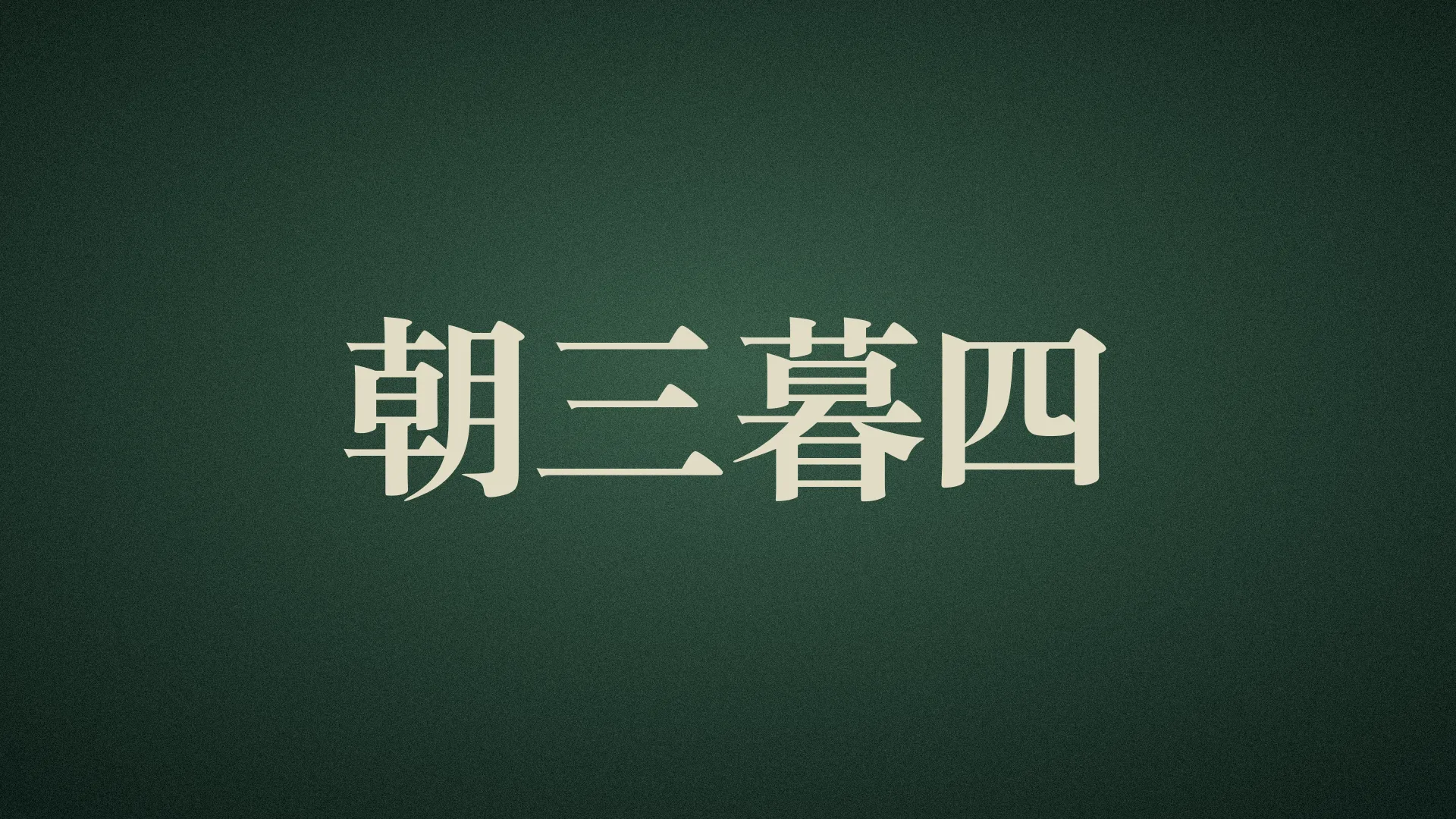
Zhuangzi defines "three in the morning" before the monkeys ever show up, and the definition isn't about monkeys. It's about people who wear out their minds over "one" without seeing that the two sides are already the same. Only then does a keeper hand out nuts, three in the morning and four in the evening, and the whole troop gets angry. He offers four and three instead, and they cheer.
The story is usually told as a joke about foolish monkeys, and the oldest commentators don't defend them. But Guo Xiang and Cheng Xuanying turn the confusion back on anyone who insists, and the idiom the story became points somewhere else again.
The Deal, Close Up
The story sits in the second of the seven Inner Chapters, 齊物論 (Qíwùlùn), a title translators have rendered many ways. James Legge called the chapter "The Adjustment of Controversies" in 1891, and Herbert Giles called it "The Identity of Contraries" in 1889. The monkey passage is two short exchanges:
狙公賦芧,曰:「朝三而暮四。」眾狙皆怒。曰:「然則朝四而暮三。」眾狙皆悅。
Our plain paraphrase: the monkey keeper (狙公, jūgōng) was handing out 芧 (xù, a nut that translators identify differently, more on that below). He said three in the morning and four in the evening, and the whole troop (眾狙, zhòng jū) was angry (怒, nù). He said, then four in the morning and three in the evening, and they were all pleased (悅, yuè).
The text doesn't say how many monkeys there were, why the keeper was rationing, or that the daily total is seven. The seven is our arithmetic, and Cheng Xuanying does the same sum. The text also says the monkeys were angry, not cheated. If that anger feels like being shortchanged, that's our reading of it.
The Line That Names It
Just before the monkeys, Zhuangzi gives the definition: 勞神明為一而不知其同也,謂之朝三 (láo shénmíng wéi yī ér bù zhī qí tóng yě, wèi zhī zhāo sān). In our paraphrase, wearing out your mind over "one" while not knowing they're the same is called "three in the morning." The pieces are 勞 (láo, to toil), 神明 (shénmíng, spirit and intelligence, roughly "the mind"), 為一 (wéi yī, something like "making it one" or "holding to one"), and 同 (tóng, the same).
The hard piece is 為一, and translators go different ways. Two public-domain translations and the commentators show the spread:
- Legge (1891) has us "toil our spirits and intelligence, obstinately determined (to establish our own view)" while we "do not know the agreement (which underlies it and the views of others)." He reads the toil as stubbornly defending your own view.
- Giles (1889) calls it "to wear out one's intellect in an obstinate adherence to the individuality of things, not recognising the fact that all things are One." He reads the toil as clinging to how things differ.
- Guo Xiang and Cheng Xuanying, in our reading of the notes that come next, take it as laboring to force things into oneness.
What the readings share is effort of mind spent while missing that the sides already match. That shared core is the safest thing to say about the line. It's also why we read the monkeys as one picture of that mental labor and not only as a target, though that reading is ours and the text doesn't announce it.
What Guo Xiang and Cheng Xuanying Add
Guo Xiang (郭象, d. 312 CE), whose commentary is embedded in the standard text, attaches a note to the monkey lines. In our paraphrase, someone who wears out the mind trying to make things one can't be relied on and is no different from people who never held to oneness. He adds that it's 亦同眾狙之惑 (yì tóng zhòng jū zhī huò), "also the same as the monkeys' confusion," going along with what you like and calling it right.
Cheng Xuanying (成玄英, a Tang dynasty Daoist writing in the seventh century) glosses 芧 as 橡子 (xiàngzǐ, an acorn), "like a chestnut but smaller." He quotes the Liezi's version of the story, says both arrangements come to seven (七數, qī shù), and asks what separates people who labor over "one" from the monkeys' confusion. His note also calls the whole reaction 愚迷 (yúmí, foolish delusion).
So the old commentary doesn't rescue the monkeys. It ties them to anyone who insists.
On the nut itself, Giles has chestnuts, Legge has acorns, and Cheng's gloss is acorn. Translators differ, and nothing in the story turns on it.
Name and Substance Unchanged
After the flip, the text delivers its hinge: 名實未虧而喜怒為用,亦因是也 (míng shí wèi kuī ér xǐ nù wéi yòng, yì yīn shì yě). 名 (míng) is the name, what a thing is called. 實 (shí) is the substance, what's actually there. 未虧 (wèi kuī) means undiminished, and 喜怒為用 (xǐ nù wéi yòng) means delight and anger were put to use. In plain words, nothing real changed and the feelings still swung.
The last clause is contested. 因是 (yīn shì) combines 因, "go along with," and 是, "this" or "right," and translators can't agree on what it does here. Legge renders the clause as "an illustration of the point I am insisting on." Giles turns it into "adaptation to the likes and dislikes of those concerned." One has the author making his point, and the other has the keeper accommodating his monkeys.
Zhuangzi then closes the thought. The sage rests in 天均 (tiān jūn, "Heaven's evenness"), which the text calls 兩行 (liǎng xíng, "walking two roads at once"). Some editions write the first term 天鈞, and Legge's footnote glosses it literally as "the Heaven-Mould or Moulder."
Where 朝三暮四 Went Later
The story survived as a four-character idiom, 朝三暮四 (zhāo sān mù sì), and its meaning moved. Taiwan's Ministry of Education Revised Mandarin Dictionary says the phrase originally refers to the story of a monkey keeper tricking his monkeys with fruit. Later it came to mean deceiving someone with a trick, or being unsettled and changeable (反覆無常, fǎnfù wúcháng). The dictionary illustrates both with the Old Book of Tang, where the phrase describes a man of crafty nature and untrue words.
Japan's Kanjipedia sits closer to Zhuangzi's own point. Its entry for the Japanese reading, chōsanboshi, says the phrase means fixating on a surface difference without noticing that things come out the same in the end, with deceiving people by smooth talk as a second sense. It names the Liezi as the source of the story.
That's a fact about usage, not about the Zhuangzi, and we've checked only these two dictionaries. But it shows the drift. The Chinese dictionary's senses are trick and changeability. Neither says whose mind is unsettled, and the first plainly belongs to the keeper. Zhuangzi's definition points at the mind that toils over "one."
The Liezi Tells It Differently
The story also appears in the Liezi (列子, Lièzǐ), in its 黃帝篇 (Huángdì piān, the "Yellow Emperor" chapter). The received Liezi is a later compilation whose date scholars dispute, so it's a parallel and not Zhuangzi's source. Cheng Xuanying quoted it in the Tang, so it was circulating by then.
The Liezi's keeper is a man of Song (宋有狙公者) who loves his monkeys, has apparently been shorting his own household to feed them, and now runs short. Fearing the troop will stop obeying him, he 先誑之 (xiān kuáng zhī), "deceives them first," with the three-and-four offer. The chapter then says a sage cages the crowd with wit the way the keeper cages the monkeys, and it ends on the same formula, name and substance undiminished, now with the keeper steering their joy and anger.
In the Liezi the offer is a deliberate trick, so the joke is on the monkeys and by extension the crowd. In the Zhuangzi nobody is called a trickster, no shortage is mentioned, and the definition comes first. The dictionary's "trick the monkeys" gloss sounds closer to the Liezi.
Were the Monkeys Wrong?
Cheng Xuanying and the Liezi both lean toward yes. The Zhuangzi never says so. It reports anger and delight and stops. Here's a reading that's ours, not the text's. Four in the morning puts food in you sooner, and if you can't be sure the evening ration will come, preferring the earlier one is a defensible bet. In the Liezi's version, where the keeper is already short and about to cut rations, it's a sensible one. For more on acting when the evening isn't guaranteed, see our post on how wu wei helps you navigate uncertainty.
The keeper's role is just as open. Giles has him adapting to his monkeys' likes, the Liezi has him deceiving them, and the Zhuangzi's 因是 line doesn't say which. We don't fully know. Verse 71 of the Tao Te Ching, on knowing and not knowing, is a fair companion to a passage that leaves this open.
A Bridge to Feeling Shortchanged
Above, we've marked what's ours as it came up. This section is ours throughout, and it goes past anything Zhuangzi says. The story is about the timing of rations, so we're borrowing it, not reporting it, and we're not attaching a named psychology effect to it.
Here's the small observation we'd take from it. Hear one piece of news about your work in two orders, "the project got praised, then it missed a deadline" and "the project missed a deadline, then it got praised." The facts are the same and the sting is different. Comparing yourself with a friend's story works the same way. "Three lean years, then the payoff" and "a fast start, then the lean years" can add up to the same stretch of life, and one of them often still feels like being shortchanged. When a comparison stings, ask first whether the totals differ or only the order, and then which side of the deal you're arguing with. If a comparison keeps replaying, our post on Taoist wisdom for letting go of anxiety is a place to go next. Remedy Eight in Eight Taoist Remedies builds a short practice on this same story.
Zhuangzi has a second case where the event stays fixed and the feeling changes. In chapter 20, a boat bumps yours on the river. If it's empty (虛, xū), even a hot-tempered man doesn't get angry. If someone is in it, he shouts at them, and by the third shout he's cursing. The text sums it up as 向也虛而今也實 (xiàng yě xū ér jīn yě shí), "before it was empty, now it's occupied." It's one of the stories in our post on Taoist parables for negative thoughts.
The analogy has limits. The monkeys' totals matched. Real comparisons often don't, and someone else really can be getting more. When the totals differ, the story has nothing to say, and that's the moment to trust the arithmetic and not the parable.
Frequently Asked Questions
What is "three in the morning" in the Zhuangzi?
It's a phrase from chapter 2 (齊物論) that the text defines as wearing out your mind over "one" without seeing that things are already the same. The monkey keeper's story follows as the illustration.
What does 朝三暮四 mean in modern Chinese?
Taiwan's Ministry of Education dictionary gives two figurative senses, tricking someone and being changeable or fickle. Japanese usage, per Kanjipedia, keeps closer to the original point of fixating on a difference that comes out the same.
Were the monkeys foolish?
The Liezi and Cheng Xuanying treat them as fooled or deluded. The Zhuangzi itself only says they were angry, then pleased, and its definition points at people who toil over "one." Whether the monkeys were wrong is a reading, not something the text settles.
What does 名實未虧 mean?
名實未虧 (míng shí wèi kuī) means name and substance were undiminished. In the story the nuts stayed the same and only the order changed, yet delight and anger (喜怒為用) still swung.
Are the monkeys' nuts chestnuts or acorns?
The word is 芧 (xù), and translators differ. Giles (1889) chose chestnuts, Legge (1891) chose acorns, and the Tang commentator Cheng Xuanying glossed it as an acorn.
Is the story also in the Liezi?
Yes, in the Liezi's 黃帝篇. There the keeper is running short of food and deceives the monkeys first. The received Liezi is a later compilation, so it's a parallel and not the Zhuangzi's source.
Other in
Principles



on our social media


Never miss an update with Tao Te Ching Translations. Subscribe to our email list.
YOUR EMAIL
JOIN NEWSLETTER