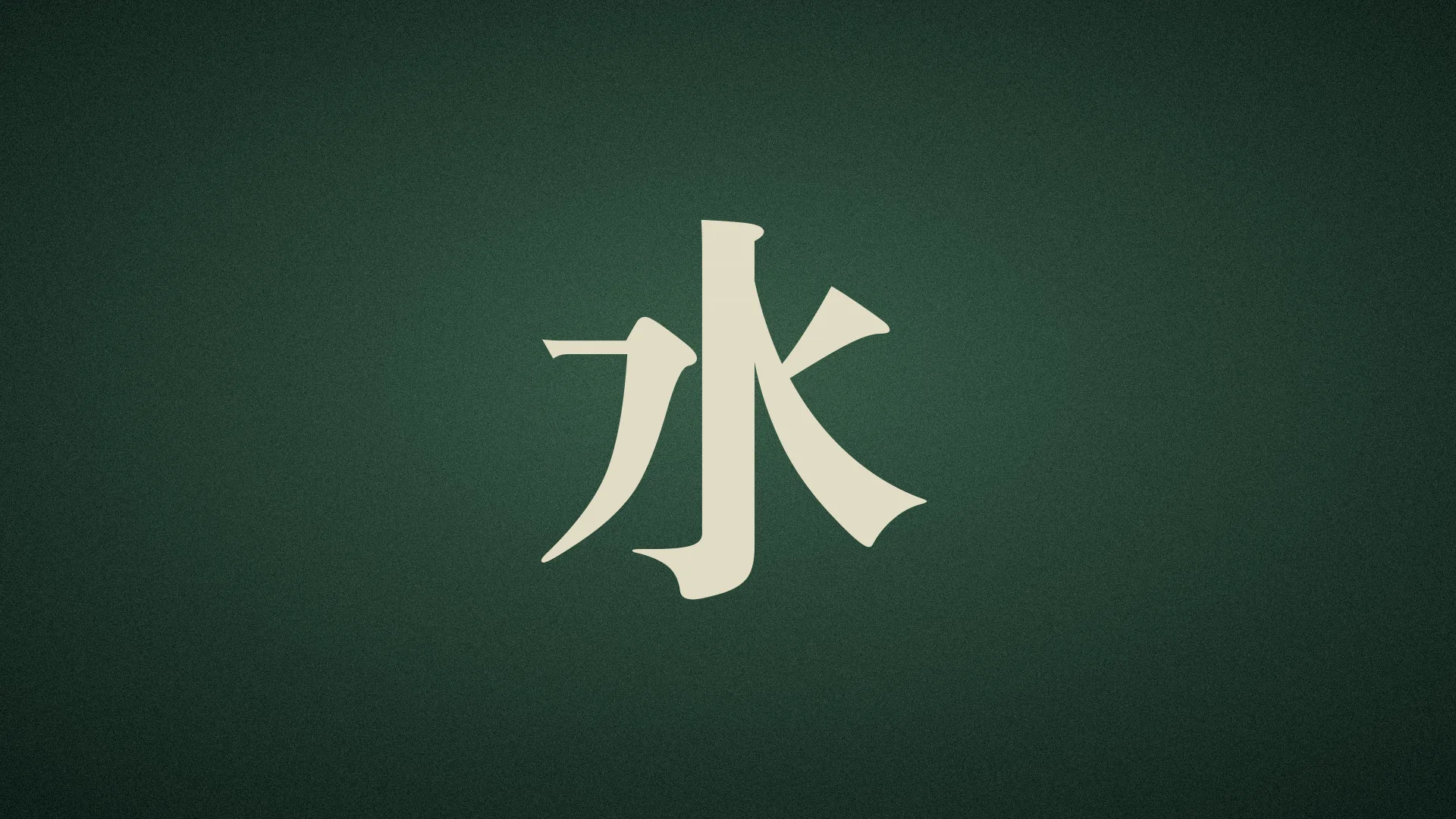
Chapter 8 of the Tao Te Ching says the highest good is like water (上善若水, shàng shàn ruò shuǐ), and then it spends most of its length listing seven things water is good at: where it settles, how deep it runs, how it gives, how it speaks, how it sets things straight, how it works, and when it moves. The chapter contains no command. The verb is 若 (ruò, "is like"), so "be like water" is a paraphrase, and the paraphrase skips the list. The Chinese rewards a slow read, because one word, 善 (shàn, "good, good at"), splits the translators, and the oldest manuscripts disagree with the standard text on several lines.
The Chinese, Line by Line
Classical source. Here is the received text, the Wang Bi version that most editions print. Wikisource carries it as a transcription rather than a critical edition, so it's a reliable copy of the standard wording and not a claim about what Laozi first wrote.
上善若水。水善利萬物而不爭,處眾人之所惡,故幾於道。居善地,心善淵,與善仁,言善信,正善治,事善能,動善時。夫唯不爭,故無尤。
Our gloss. The right-hand column below is our own plain, literal gloss of the Chinese. It isn't taken from any published translation, and where a word can go two ways we say so.
| Chinese | Pinyin | Literal gloss |
|---|---|---|
| 上善若水 | shàng shàn ruò shuǐ | The highest good is like water |
| 水善利萬物而不爭 | shuǐ shàn lì wànwù ér bù zhēng | Water is good at benefiting the ten thousand things (萬物, all things) and does not contend (爭, zhēng) |
| 處眾人之所惡 | chǔ zhòngrén zhī suǒ wù | It settles in the places the many people dislike |
| 故幾於道 | gù jī yú dào | So it comes near (幾, jī) the Way (道, dào) |
| 居善地 | jū shàn dì | In dwelling, good at the ground, the right place |
| 心善淵 | xīn shàn yuān | In the heart-mind (心, xīn), good at depth (淵, yuān, a deep pool) |
| 與善仁 | yǔ shàn rén | In dealing with others, or in giving, good at humaneness (仁, rén) |
| 言善信 | yán shàn xìn | In speech, good at good faith (信, xìn) |
| 正善治 | zhèng shàn zhì | In setting things straight, good at order (治, zhì) |
| 事善能 | shì shàn néng | In affairs, good at capability (能, néng) |
| 動善時 | dòng shàn shí | In moving, good at timing (時, shí) |
| 夫唯不爭,故無尤 | fú wéi bù zhēng, gù wú yóu | Only because it does not contend, it has no fault (尤, yóu, "fault, blame") |
Read the middle of that table as a grammar and the design shows. Each of the seven short lines names an area of life first (dwelling, heart, dealing, speech, setting straight, affairs, moving) and then a skill in that area. The chapter describes someone who is good at seven things, and the someone happens to be a river.
Why 善 Is the Word That Matters
善 (shàn) appears nine times in the chapter. We counted it ourselves in the received text: twice in the opening two lines (上善 and 水善利萬物) and once in each of the seven short lines. That count is ours and not a published figure, so recount it if you're going to lean on it.
The character carries two jobs. As a noun it means "the good," the thing worth being. As a verb of skill it means "to be good at," the way a carpenter is good at joinery. The chapter uses both and doesn't announce the switch. The first line's 上善 can be heard as "the highest good" or as "the best kind of goodness," and by the seventh short line 善 plainly means "skilled at."
Chapter 66 reaches for it again when it praises the rivers and seas as 善下之, "good at being below" (more on that below), and in both places it's closer to "skill" than to "virtue" as most English readers hear that word. Every translator has to decide which half of 善 to carry into English, and that single decision explains most of what's different in the next section.
How Translators Handle the Water
Classical source, translated. The table below gives a short phrase from each translator for the opening line and for one other choice, each credited to translator and year. Legge, Carus, Goddard, Mears and Heysinger are public domain, and full texts are on our Legge 1891, Carus 1913, Goddard 1919, Mears 1916 and Heysinger 1903 pages. Mair (1990) and Mitchell (1988) are in copyright, so they appear here only as short snippets, and the full versions are on our Mair and Mitchell pages.
| Translator, year | 上善若水 | Another choice in the chapter |
|---|---|---|
| James Legge, 1891 | "The highest excellence is like (that of) water" | The mind's excellence is "abysmal stillness." The one of highest excellence "does not wrangle." |
| Paul Carus, 1913 | "Superior goodness resembleth water" | "It quarreleth not. Therefore it is not rebuked." |
| Isabella Mears, 1916 | "Heavenly Love is like water" | "In his heart he loves Infinity" |
| Dwight Goddard, 1919 | "True goodness is like water" | For the heart, "the circling eddy" |
| Heysinger, 1903 | "highest goodness that we know has water for its type" | The Way is water's "archetype" |
| Victor H. Mair, 1990 | "The highest good is like water" | Water "but also struggles." Giving "lies in trust." |
| Stephen Mitchell, 1988 | "The supreme good is like water" | "In thinking, keep to the simple." The close becomes "don't compare or compete." |
Three things differ, and none of them is a matter of one translator being right. The first is how 善 lands in line one. Legge chooses "excellence," which can lean toward skill. Carus, Goddard, Heysinger, Mair and Mitchell choose forms of "good" or "goodness," which lean toward morals. Mears reaches for "Heavenly Love," a devotional reading the Chinese doesn't require.
The second is 心善淵, where the range is widest. Legge's "abysmal stillness" hears depth as calm, Goddard's "circling eddy" hears it as motion, and Mitchell's "keep to the simple" is a loose paraphrase that keeps the spirit and drops the pool. Read Mitchell as his interpretation of the line and not a gloss of the words.
The third is 不爭. Legge's "wrangle" and Carus's "quarreleth" both hear it as verbal dispute. Mitchell turns the ending into advice to the reader, "don't compare or compete," which widens it to an inner habit. Mair's "but also struggles" goes the other way, because his 1990 translation relies on the Mawangdui manuscripts, which we come to below. For a broader look at how the same lines shift between literal and poetic renderings, see literal vs poetic Tao Te Ching translations and our comparison of five classical translations.
What the Commentators Say
Classical source. Two early commentaries on this chapter survive in the received tradition, and they read the water differently. Wang Bi (226 to 249 CE) is terse and philosophical. Heshang Gong is concrete and physical. His dating is uncertain. Wikipedia, citing Dan Reid's 2019 translation of the commentary, dates it to around 130 CE, and the traditional story of a hermit who taught Emperor Wen is legend, so treat the name as a label for a text and not a biography.
Wang Bi: lowness and "near"
On 處眾人之所惡, "it settles where the many people dislike," Wang Bi writes 人惡卑也, "people dislike lowness." That's the whole note, and it names what the line is about. The places the crowd avoids are low places, and water goes there without being sent.
His note on 故幾於道 is longer and better: 道無水有,故曰幾也. In our gloss, "The Way has no being (無, wú), water has being (有, yǒu), so it's called 'near.'" Water sits near the Way without being it, and the word 幾 (jī, "near") does exactly that job. The chapter never says the highest good is the Way, and Wang Bi makes sure nobody reads it that way.
Heshang Gong: what water does
Heshang Gong's notes stay with the water itself, and in the Wikisource transcription of his text each one sits under its line. On the opening line he writes 上善之人,如水之性, "the person of highest goodness is like water's nature," so his subject is a person and not the cosmos. On the low places he writes 眾人惡卑濕垢濁,水獨靜流居之也, "the many people dislike what is low, damp, filthy and muddy, and water alone flows quietly and settles there."
Under 事善能, "in affairs, good at capability," he says water can be square or round and bends or runs straight to fit its container (能方能圓,曲直隨形). Under 動善時, "in moving, good at timing," he says it scatters in summer and congeals in winter, moving in answer to the season without losing the timing of heaven (夏散冬凝,應期而動,不失天時). Under 故無尤 he writes that people under heaven have no complaint against water (天下無有怨尤水者也), which is the "draws no blame" reading of the last line, from a commentator and not just from us.
Together the two commentators show a split that's still with us. One reads the chapter as a claim about being and the Way, and the other reads it as a description of how a good person behaves in a room.
The Low Places
Most retellings skip 處眾人之所惡, the line about the places people dislike, and go straight to "flow." That's a loss, because this line is what makes the chapter more than a compliment to water.
Chapter 66 gives the same idea a political shape: 江海所以能為百谷王者,以其善下之, "the rivers and seas can be kings of the hundred valleys because they're good at being below them" (百谷王, bǎi gǔ wáng, "king of the hundred valleys"). Legge's 1891 wording is "their skill in being lower than they." Water gets its rank by taking the lowest position, and everything runs toward it. Read next to chapter 66, the low places in chapter 8 look less like a hardship water puts up with and more like the source of its reach.
Our interpretation. This is why we'd read chapter 8's list as a lesson in where to stand. Six of the seven skills are about how to act, and the first is about where to be. The order may be deliberate, but the text doesn't tell us that it is.
Where the Texts Disagree
Classical source. The received text isn't the oldest witness. Two silk manuscripts of the Laozi, known as Mawangdui (馬王堆, Mǎwangduī) A (甲) and B (乙), come from a tomb sealed in 168 BCE. They differ from the received text in several places in this chapter. The transcription we checked, on Wikisource, carries its own quality rating of about 50 percent, so what follows is a pointer for someone with a published edition in hand and not a finding.
- 與善仁 or 予善天. Where the received text has 與善仁 ("good at humaneness"), Mawangdui B appears to read 予善天 (yǔ shàn tiān, "in giving, good at Heaven"). Mawangdui A appears to read 予善信 (yǔ shàn xìn, "in giving, good at trust") and has six of the good-at lines instead of seven. Mair's "giving lies in trust" follows that shape.
- 不爭 or 有爭. Both silk copies, as transcribed, have 有 (yǒu, "has") where the received text has 不 (bù, "does not"). Water is then good at benefiting things "and has contention," which is Mair's "but also struggles." Copy A writes 有靜, with 靜 (jìng, "still") in the slot where B has 爭. Whether that's a variant writing of the same word or a different reading is a question for specialists. The closing line still says "does not contend" in B (夫唯不爭) and "does not still" in A (夫唯不靜), and we haven't found a source we can cite for how specialists reconcile the two.
- 正 or 政. Some received editions write 政 (zhèng, "govern") where most write 正 ("set straight"), according to the variant list on Wikisource. The pronunciation is the same, and the meaning shifts from setting things right toward running a state.
- 無尤 two ways. 尤 (yóu) means fault or blame, and 無尤 can be read as "water has no fault" or as "water draws no blame." Carus's "not rebuked" and Heshang Gong's note above take the second. Both readings fit 夫唯不爭, "only because it does not contend."
None of this changes the chapter's main shape. It does mean that anyone who tells you exactly what chapter 8 "really says" at these four points is choosing a text first and reading it second.
What Chapter 8 Leaves Out
Nothing in chapter 8 says water wears down stone. That idea comes from chapter 78: 天下莫柔弱於水,而攻堅強者,莫之能勝, "nothing under heaven is softer or weaker (柔弱, róuruò) than water, yet for attacking the hard and strong nothing can beat it." That's a claim about strength through yielding, and it's the idea many people have in mind when they say "be like water." It belongs to a different chapter with a different argument.
Chapter 8 is about skill and standing. Chapter 78 is about strength and softness. Keeping the two apart gives you two ideas where a blended quotation gives you one vague one. For the wider water thread, the water sections in our posts on seven ancient Tao principles for modern stress relief and seven Taoist practices for inner resilience are a good next stop, and the history of wu wei (無為, wú wéi, "non-action") shows where these ideas sit in the larger tradition.
From the Low Place to Your Tuesday
Modern practice. This section is ours and isn't classical. The chapter's most practical detail is the one people skip, the low place. Here's a small experiment built on it, the kind of practical Taoism that costs nothing to try.
Pick one task you consider beneath you. It might be the dishes, the unglamorous report, the errand you keep handing off. Do it for one day without commenting on it, out loud or in your head. No sighing, no narration about how it's not your job. Then pick one place where you're contending with someone, an argument you keep rehearsing or a small competition with a colleague, and notice each time you reach for it.
Nobody's keeping score. The picture the chapter draws is of someone who does the low job well and has nothing left over to spend on a quarrel. It may not fit your week that neatly, and some contests are worth having. At the end of the day, ask what the low task cost you and what the contention did.
Day 3 of the Book of Tao Flow Course is built around this chapter, if you'd like a guided version of the same idea. For a set of short lines to carry around while you try the experiment, see 10 Taoist affirmations for inner peace.
Questions About Tao Te Ching Chapter 8
What does chapter 8 of the Tao Te Ching say?
It says the highest good is like water, which benefits all things without contending and settles in the places people dislike. It then lists seven areas where water shows skill: dwelling, the heart, giving, speech, ordering, work and timing. It ends by saying that because water doesn't contend, it has no fault.
What does 上善若水 mean?
上善若水 (shàng shàn ruò shuǐ) means "the highest good is like water." 上 (shàng) is "highest," 善 (shàn) is "good" or "good at," 若 (ruò) is "is like," and 水 (shuǐ) is "water." Translators split on whether 善 leans toward moral goodness or toward skill, which is why you'll see "excellence," "goodness" and "the supreme good" for the same phrase.
Does the Tao Te Ching say "be like water"?
No. Chapter 8 uses 若 (ruò, "is like"), which describes and doesn't command. The idea that water overcomes the hard through softness is in chapter 78, and the phrase "be like water" doesn't appear in the text of either chapter.
Why is water compared to the Way?
The text says water is "near" the Way (幾於道), not identical to it. Wang Bi explains that the Way has no being and water has being, so water can only come close. What earns the comparison in the chapter is that water benefits all things, goes to low places and doesn't contend.
What does 不爭 mean?
不爭 (bù zhēng) means "does not contend," "does not struggle" or "does not quarrel." In this chapter it describes water's way of benefiting things without competing for credit or position. The Mawangdui silk copy B reads 有爭 ("has contention") at one point, so some modern translations, such as Mair's 1990 version, translate that line differently.
Why does the character 善 appear so often in chapter 8?
善 (shàn) appears nine times in the received text, by our count. It means both "good" and "good at," and the chapter uses it once for the highest good, once for water's benefit to things, and seven times for water's skills. The repetition is the chapter's structure, and it's also the reason translations of the same line can sound so different.
Other in
chapters-guide



on our social media


Never miss an update with Tao Te Ching Translations. Subscribe to our email list.
YOUR EMAIL
JOIN NEWSLETTER